
"The new revolution in transportation will not be technological. It will be behavioral."
Today, in the MOBS2 newsletter, we are sharing the speech given by MOBS2 Co-CEO Rebeca Leite at the National Seminar of the National Association of Urban Transport Companies, which took place in Brasília on August 12th and 13th of this year. The text is impactful and forward-thinking. We highly recommend reading it.
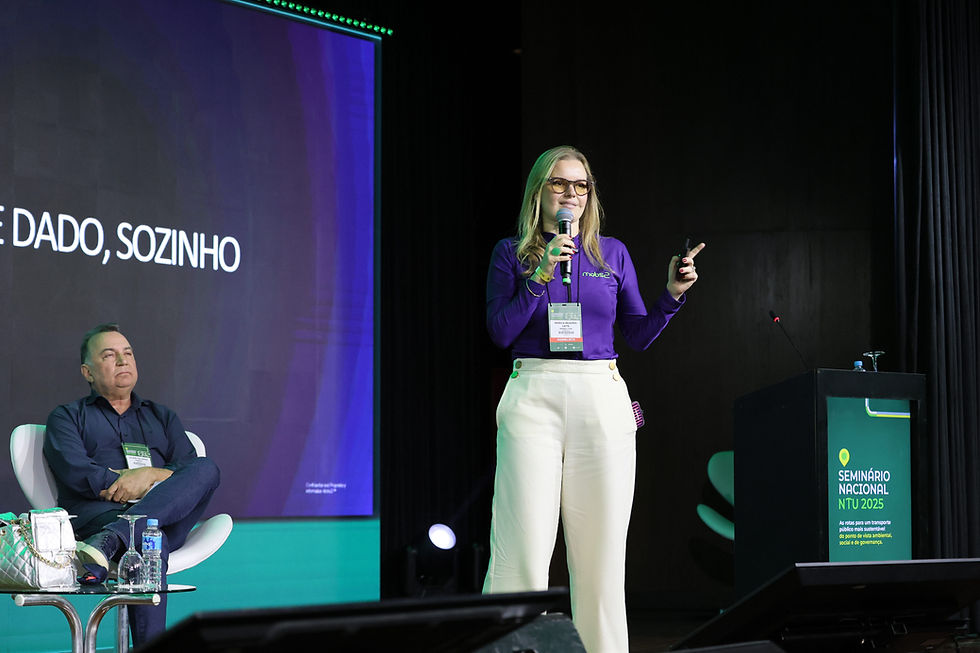
Speech by Rebeca Leite in Brasília – August 12, 2025
"No, it wasn't by chance that I came up here wearing these Ray-Ban sunglasses."
For a long time, this name was synonymous with "good taste" and protecting the eyes from the sun's rays. Today, they continue to do that… but they go much further. What I'm wearing now is a Ray-Ban with artificial intelligence, developed in partnership with Meta. It's filming, analyzing my surroundings and, most importantly, learning about my behavior in real time.
Why do I start with this? Because this simple object, which once served only to protect our vision, is now capable of recording patterns, understanding reactions, and offering intelligent responses. It's a symbol of the times we live in: technology has stopped looking only at the world around us… and has started looking at us. And this change is everywhere: in healthcare, retail, industries… and, of course, transportation.
But there's an even deeper transformation happening—one that almost no one sees. A silent, invisible revolution. It's the behavioral revolution. Because behind every machine, app, or sophisticated system… there's still a human being making decisions. And that's what we're going to talk about today: how understanding, measuring, and transforming behavior is what truly changes the results—especially in passenger and freight transportation.
When it comes to innovation in transportation, the image that comes to mind for many people is always similar: modern vehicles, state-of-the-art embedded systems, and apps with beautiful interfaces and packed with features.
But the truth is that none of this, by itself, guarantees a better result. After all, a new bus, a technological truck, or a motorcycle equipped with sensors doesn't, on its own, change the way people are driven. True innovation begins with a simple—yet challenging—question: How are people behaving while driving?
In recent years, transportation has embraced the data age. Today, we have GPS, rotation sensors, cameras, and onboard telemetry in almost every type of fleet. The problem is that there's a huge difference between collecting data… and transforming data into intelligence. And this is where many systems stop halfway. They capture information, display it in graphs, store it in reports—but do nothing to change the reality that this data reveals. Because data, alone, doesn't educate. It doesn't inspire. It doesn't correct. The real challenge is transforming numbers and alerts into action, into learning, into a change of course—in both the literal and behavioral sense.
To understand the magnitude of this challenge, consider a simple example. Imagine a fleet that collects thousands of telemetry records every day: speeding, hard braking, idling, excessive acceleration. This data clearly shows where the problem lies—but it doesn't solve anything on its own. Without immediate action, the driver will continue making the same mistakes, and the company will continue accumulating costs and risks.
This is where a crucial point comes in: the time between the occurrence of the problem and the corrective intervention. In many management models, the correction only happens weeks later, in a meeting or generic training session. In that interval, the driver has already repeated the mistake dozens, perhaps hundreds of times.
Now, imagine the reverse scenario: every time an error occurs, the driver receives targeted feedback, tailored to their behavior, and specific guidance on how to correct it. This isn't just technology. It's technology with purpose. It's creating a continuous cycle of observation, correction, and improvement. And when that response is quick, personalized, and recurring, the numbers start to change. Fewer incidents. Less waste. More safety. More efficiency. All because someone decided that data isn't just for recording what happened, but for changing what will happen in the future.
When technology is used to generate action—and the action is designed to change behavior—the results appear. In operations that have adopted this model of rapid and personalized intervention, we have seen consistent reductions of up to 75% in serious accidents on high-risk routes. We have also observed a drop of over 60% in events per kilometer driven, which means less mechanical wear and more predictable maintenance. And the impact is not just on safety: there are cases with fuel savings of up to 25%, resulting from more conscious driving.
Furthermore, there are intangible effects that translate into concrete gains:
1. Greater punctuality in deliveries or transport schedules;
2. Reduction of absences due to stress or fatigue;
3. Increased engagement and sense of responsibility among drivers;
4. Greater customer or passenger satisfaction, because the experience is directly impacted by how the driver acts.
These results don't happen by chance. They are the consequence of a method: observe, interpret, intervene, and measure again. It's a continuous cycle of improvement that transforms the operation from the inside out.
The next revolution in transportation will not be merely technological. It will be behavioral. We can invest in more modern vehicles, more sophisticated systems, and increasingly comprehensive applications—but none of this reaches its full potential if there is no change in the way the people who drive these vehicles think and act. Because, at the heart of transportation, it's not the machines. It's the people. And it is human decision-making that, at the end of the day, determines whether a journey is safe, whether fuel is wasted, whether deadlines are met, and whether the customer or passenger arrives satisfied.
When drivers understand the real impact of each choice—every turn, every acceleration, every second idling—they begin to act more consciously. When they realize they are seen, recognized, and supported, they engage and improve. And when there is a system that transforms mistakes into learning opportunities, evolution ceases to be a distant goal and becomes a daily routine. This is the true power of any innovation in transportation: the power to change mindsets and habits, so that technology can deliver everything it promises.
If there's one thing experience in the transportation sector teaches us, it's that data alone doesn't change anything. It shows the problem, but it doesn't solve it. What transforms the scenario is how we act upon it—and, above all, how we prepare the people at the center of it all. And this is where the most important message I want to leave you with today comes in: True transformation begins where no one sees it. It begins in the invisible. It begins with behavior. Technology allows us to see clearly. But it is education that gives us the ability to act intelligently.
When we combine the two, we can reduce costs, increase efficiency, improve the passenger experience and, above all, save lives. This is the vision behind MOBS2. We are not just a telemetry provider. We are a strategic partner that helps companies and managers transform data into action, action into learning, and learning into real results.
If your organization wants to take the next step—and transform not only the fleet, but also the people who operate it—then our invitation is simple: Let's make this invisible revolution happen and make it visible in your results. I'm Rebeca Leite, Co-CEO of MOBS2, a company that has revolutionized fleet management. Thank you very much.
Brasilia, August 12, 2025



Comments